

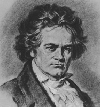
    LUDWIG VAN BEETHOVEN  |

LUDWIG VAN BEETHOVEN
Where to begin? Beethoven was the giant, under whose shadow every composer since him has labored. Brahms acknowledged his indebtedness
to Beethoven, when critics of the Brahms first symphony commented that it sounded like Beethoven's tenth (he only wrote nine). Brahms replied that
any fool could see that. So heavy was the burden of working in Ludwig's shadow, that it took Brahms two decades to produce his first
symphony.
Beethoven lived during one of those unique periods of transition in western history. You'll see by the date of his birth that his life spanned
a period of violent revolution. The Boston Tea Party, precursor to the American War of Independence, took place in 1770, the French Revolution began
in 1789, Napoleon's invasion of Russia was in 1812 (though Tchaikovsky's overture was written much later, in 1882). All across Europe, the
established monarchical way of life was beginning to crumble.
It is in this atmosphere of aristocracy in decline/democracy on the rise, that Beethoven lived and worked. The third symphony of Beethoven, called
"Eroica" (Heroic) was originally dedicated to Napoleon Bonaparte. But when Napoleon declared himself Emperor, Beethoven struck the dedication
from the page and instead inscribed it to the memory of a great man. Or so the story goes. And why not believe it? It suits the work, and it
fits with other stories told about Beethoven, the man.
This heroic symphony is a radical departure from the music of the Classical period (Mozart, Haydn, and others) into which Beethoven was born,
and in which he studied his craft. It is longer, by far, than any symphony before, including his own first two symphonies, and many since. And
it is definitely not the genteel, delicate work that sounds so much like the music of the aristocracy. It is a monumental work! The first movement
alone is longer than many of the symphonies of its time, and it opens with two crashing chords and a deeply voiced melody played over a pulsing
orchestral accompaniment. It is as if, with a stroke of his pen, Beethoven threw away the musical philosophy of the past, and opened the door to an
unknown future.
There is, possibly, another factor involved in the dramatic difference between the music of Beethoven and that of his predecessors and
contemporaries. It is my belief, that sometime during the early years of the nineteenth century, he had an experience of, what Dr. Bucke
calls, Cosmic Consciousness.
It was during this period that Beethoven's hearing began its serious decline. His letter to his brother, the Heiligenstadt Testament,
clearly delineates the composer's concern. (Imagine, if you will, how truly distressing such an occurrence must have been to this
musical giant.)
But, something happened to Beethoven that enabled him to carry on. And, not just carry on. Beethoven transcended the musical traditions
of his time. Dr. Bucke explains, in his book, how the cosmic illumination experience seems to come on an individual in a flash. An
explosion, if you will, of insight into the nature of reality and the Godhead.
Clearly, the dramatic opening chords of the Eroica Symphony evokes this experience. And, as with Walt Whitman and Honoré
de Balzac and others, where their previous artistic output was, at best, competent, their subsequent work, is unaccountably brilliant
and remarkably important. This improvement is sudden, not gradual.
This is not the result of maturity, nor the product of prolonged study. There is a clear and complete, instantaneous transformation
of the person and their artistic output. And so it is with Beethoven.
This experience had a lasting effect on Beethoven. So much so, that in his later years, stone deaf, he was inspired to set to music,
the Ode to Joy of Schiller. What joy could there have been, for the composer, in his deafness? Surely, none. The joy Beethoven expressed in his symphony
was certainly inspired by the spiritual joy which had filled him more than twenty years before, and had stayed with him through his
entire life.
In every format in which he composed, whether it was the symphony, the piano sonata, or the concerto,
Ludwig boldly went where no one had gone before. One of my favorite Beethoven works is the Third Piano Concerto. It's a piece of music firmly rooted in the classical tradition. But, it has attitude!
The first movement opens with the musical themes stated by the orchestra, in much the same way as any concerto my Mozart. In fact it bears a
remarkable similarity to the opening theme of Mozart's 24th Piano Concerto (Mozart was certainly busy!) But there's a distinct difference. Where Mozart's opening melody
is beautiful and plaintive, the Beethoven first theme is possibly the sneakiest melody ever written.
He wrote subtle transitions to connect movements that previously had stood alone. He replaced the
refined minuet movement (common in the symphonies of his time) with a movement he named the scherzo, Italian for JOKE!
He made demands on musicians, instruments, and on his audiences, that were unheard of in his time. He added new and novel instruments to
to his sound palette.
He was, THE COLOSSUS.
|
 
|


© 1998 Kenneth Marc Levy